

How to Choose a Dump Truck Hydraulic Cylinder
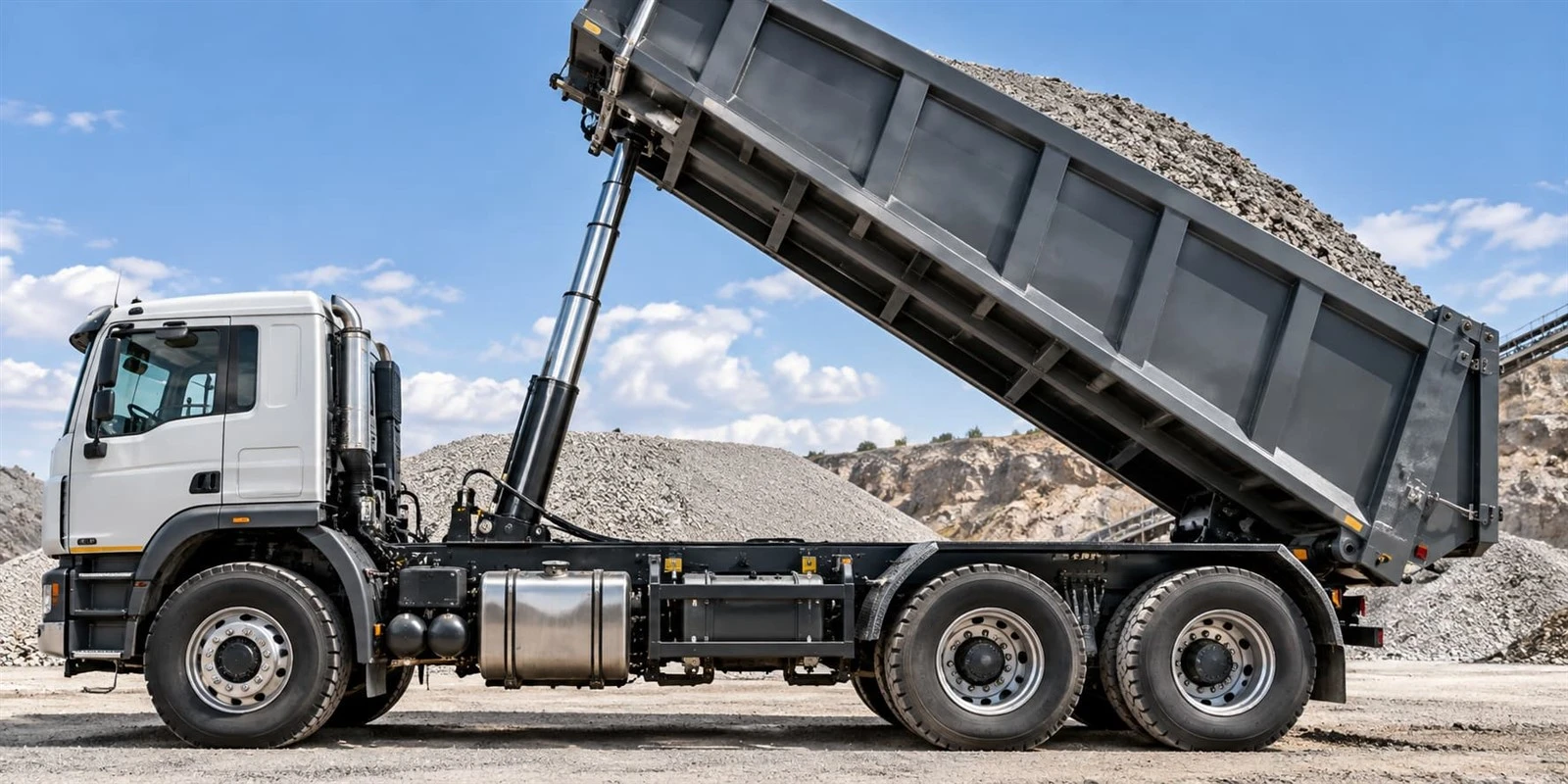
A dump truck hydraulic cylinder has to do more than lift the rated payload. It must produce enough force when the body first starts to rise, fit beneath the lowered body, provide the stroke needed for the dump angle, and remain stable throughout the lift.
For a replacement or new hoist design, work from the loaded body weight and center of gravity through the hoist geometry before selecting cylinder size. Then check pressure, stroke, closed length, mounts, and operating conditions.
DALLAST lists dump truck cylinders and telescopic cylinders for applications that need a long stroke in limited installation space.
Calculate the Force Needed to Start the Lift
Payload weight alone does not tell you the required cylinder thrust. The dump body rotates around its rear hinge, and the cylinder must overcome the moment created by the loaded body.
For a preliminary calculation:
Load moment = W × x
Where:
W is the weight of the loaded body, in pounds.
x is the horizontal distance from the rear hinge to the combined center of gravity, in inches.
Then estimate cylinder force:
Cylinder force = Load moment ÷ d
Here, d is the perpendicular distance from the rear hinge to the cylinder's line of action. Check this distance near the start of the lift, when the hoist may have its poorest mechanical advantage.
Worked example
Suppose a truck carries a 16,000 lb payload in a 3,000 lb dump body. The combined weight is 19,000 lb, its center of gravity is 60 in ahead of the rear hinge, and the cylinder's effective moment arm at lift initiation is 30 in.
Load moment = 19,000 × 60 = 1,140,000 lbf·in
Theoretical cylinder force = 1,140,000 ÷ 30 = 38,000 lbf
Using an illustrative design factor of 1.5:
Design force = 38,000 × 1.5 = 57,000 lbf
At 2,500 psi, the effective lifting area would be:
Required area = 57,000 ÷ 2,500 = 22.8 in²
Using D = √(4A/π), that area corresponds to a piston diameter of about 5.39 in. A preliminary design would therefore examine a bore or effective stage diameter of roughly 5.5 in or larger, subject to the actual hoist geometry and the cylinder manufacturer's design.
At 3,000 psi, the same 57,000 lbf requires about 19 in² of effective area, equivalent to a diameter of approximately 4.92 in. Pressure and effective area must be considered together. These calculations do not justify raising system pressure: the pump, valve, hoses, fittings, cylinder, and structure must all be rated for it.
Check stability as well as thrust
A conventional single-stage cylinder rod also needs a buckling check. For illustration, a 2.5 in solid steel rod with a 48 in unsupported length has a second moment of area of approximately 1.92 in⁴. A pinned-pinned Euler calculation gives a critical load of about 246,000 lbf, or an illustrative screening load of 82,000 lbf with a factor of 3.
If the mounting behaves more like a cantilever, with an effective-length factor of 2, that screening load falls to about 20,500 lbf. Mounting conditions can therefore change the result substantially.
A telescopic cylinder needs a different assessment: each stage has its own diameter, overlap, and unsupported length. Use the manufacturer's stage-stability method rather than treating the smallest stage as an ordinary rod.
Cylinder capacity also does not change the truck's legal payload. Check the chassis GVWR, axle ratings, body-builder limits, hinge, subframe, and hoist ratings separately.
Determine Stroke from the Hoist Geometry
Bed length alone cannot establish the required stroke. Record the rear hinge center, chassis cylinder pivot, and cylinder attachment point on the body. You also need the lowered center-to-center cylinder length, desired dump angle, available extended length, and clearances around the chassis, PTO, crossmembers, exhaust, axle, and body.
Once the pivot positions are known, calculate the cylinder length with the body lowered and at the required raised angle:
Required stroke = Raised cylinder length − Lowered cylinder length
For example, suppose the chassis pivot is 36 in forward and 6 in below the rear hinge, while the body attachment is 84 in forward of the hinge. The cylinder length is approximately 48.4 in at a 0° body angle and 72.6 in at a 50° angle. The geometric travel is therefore about 24.2 in.
That figure still needs checks for end clearance, pivot articulation, mechanical stops, manufacturing tolerances, and interference throughout the lift. Commercial dump and hook-lift bodies include examples with angles around 50–54°, but the required angle depends on the material, body, and unloading conditions. There is no universal 45°, 50°, or 60° target.
For a replacement cylinder, document the closed and extended lengths, individual telescopic stages, pins, mounts, and ports. DALLAST's hydraulic cylinder measurement guide is a starting point. Pin diameter, retaining hardware, bracket thickness, and bolt torque must come from the approved hoist and cylinder design; payload tonnage alone cannot determine them.
Never work beneath a raised dump body supported only by hydraulic pressure. OSHA's construction rule requires a permanently attached positive support that can be locked in position during maintenance or inspection.
Single-Stage or Telescopic Cylinder?
The choice usually comes down to the stroke needed and the space available when the body is lowered.
| Factor | Single-stage cylinder | Telescopic cylinder |
|---|---|---|
| Retracted length | Relatively long | Compact relative to its available stroke |
| Stroke | Limited by installation space | Suited to long-stroke applications |
| Sealing points | Fewer | More |
| Repair complexity | Generally lower | Generally higher |
| Stability check | Rod buckling | Stability of each stage |
| Common arrangement | Underbody or scissor hoists; smaller dump bodies | Front-end hoists needing a long stroke |
A telescopic cylinder is a practical option when a single-stage unit cannot provide the required stroke within the available closed length. DALLAST lists a front-end telescopic hydraulic cylinder for dump-truck systems, as well as pin-eye, trunnion, and related mounting arrangements in its dump-cylinder range.
Front-end telescopic cylinders are common on larger construction and bulk-material bodies. Underbody single-stage or scissor-hoist arrangements may suit smaller landscape bodies and trailers when the chassis space and load geometry allow them.
Many telescopic dump cylinders are single-acting: hydraulic pressure raises the body, and gravity retracts the stages as the empty body lowers. Choose the number of stages for the required geometry and stability, while accounting for the additional seals, sliding surfaces, and manufacturing tolerances.
Match Materials, Seals, and Fluid to the Job
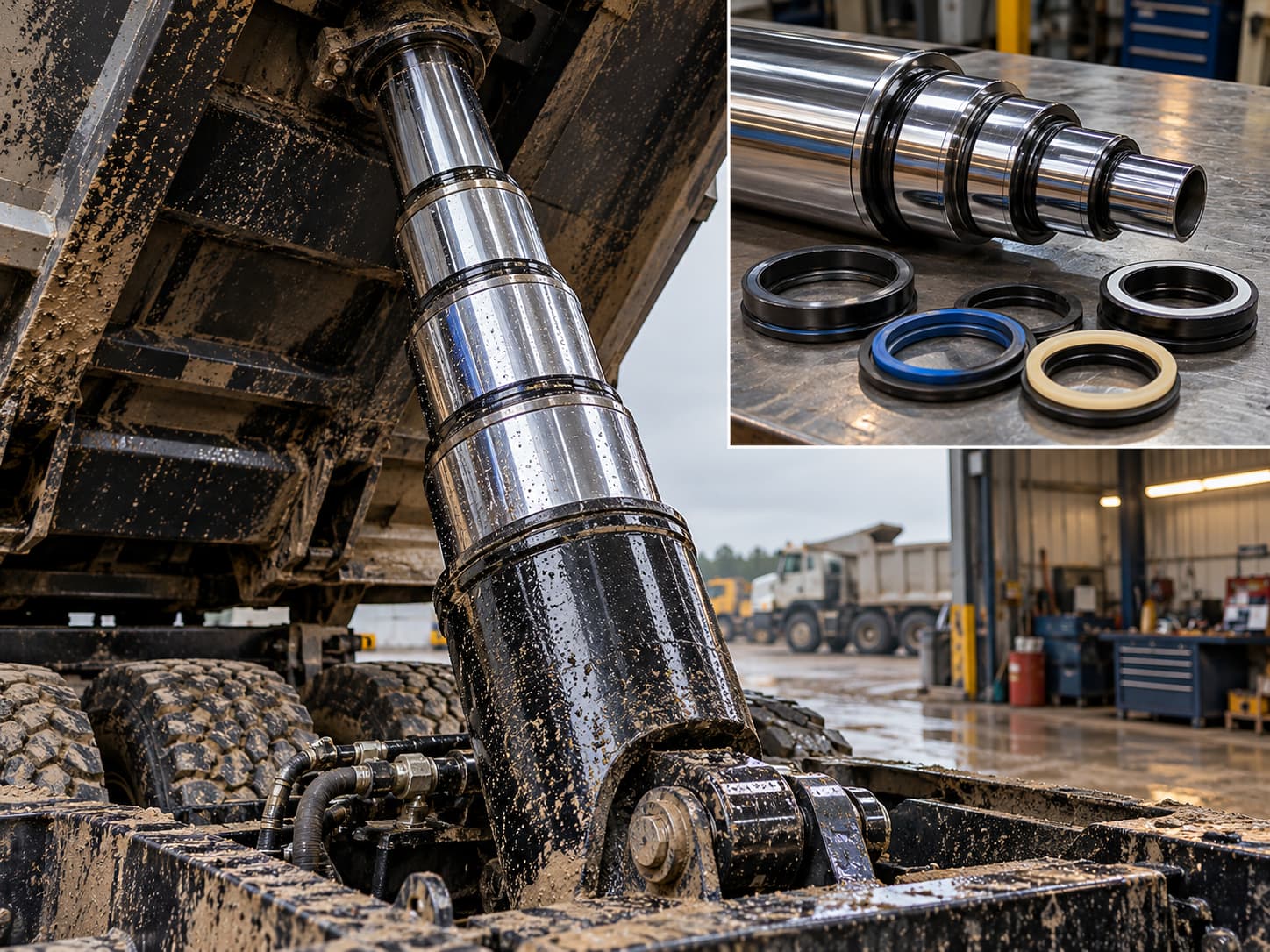
Road spray, salt, mud, aggregate dust, temperature changes, and time spent with stages exposed all affect cylinder life.
| Operating condition | Points to check |
|---|---|
| Cold starts and winter service | Low-temperature seal compatibility, fluid viscosity at startup, and salt protection |
| Hot operation | Seal temperature limits and fluid viscosity at operating temperature |
| Coastal or salted roads | Coatings, protected hardware, washing, and inspection |
| Dusty aggregate sites | Wipers, stage finish, and filtration |
| High-cycle fleet service | Seal wear and scheduled pin and bushing checks |
NBR, HNBR, FKM, and polyurethane are used in hydraulic seals, but the material name alone does not establish suitability. As broad material references, Parker's O-ring handbook places some general-service NBR compounds around −30°F to 250°F; HNBR and FKM can support higher-temperature applications. Basic polyurethane compounds may have narrower ranges, while specialized hydraulic grades can go further. The exact limits depend on the compound and fluid. Parker also lists NBR, HNBR, FKM, and TPU among materials used for mineral-oil hydraulic sealing.
Choose hydraulic fluid by the acceptable viscosity range of the pump, valve, and cylinder at both cold start and normal operating temperature. A high-viscosity-index fluid may help where seasonal temperatures vary widely. Do not assign ISO VG 32 or ISO VG 46 solely by region.
For severe salt exposure, consider stronger coating systems and corrosion-protected pins and hardware. Stainless steel may be useful for selected parts, but it is not automatically needed throughout a large telescopic hoist.
Plan for Maintenance and Total Cost
A lower purchase price can lose its advantage if seals, stages, or replacement parts are hard to obtain. Problems worth watching for include seal leakage, chrome damage, corrosion, bent or scored stages, contaminated oil, pin and bushing wear, aeration or cavitation, damaged brackets, slow extension, and seal extrusion after pressure spikes.
A practical fleet inspection routine is:
Before operation: Look for leaks, damage to exposed stages and hoses, loose mounting pins, and unusual movement.
Monthly: Check pivot-pin play, brackets, wipers, stage surfaces, oil level, and hose routing.
Quarterly or according to duty: Review filters, oil condition, contamination, tipping time, pressure behavior, and mounting wear.
Record measurable changes where possible, such as pin clearance, leak accumulation, lifting time, operating pressure, and the location of visible corrosion.
Slow lifting does not automatically mean the cylinder needs replacing. Check PTO and pump output, oil level and viscosity, relief-valve setting, restrictions, valve operation, and internal bypass first.
Rebuild or replace?
U.S. online listings cited in the source article advertised several replacement telescopic dump-hoist cylinders at about $1,850–$3,187, before freight, installation, tax, or truck-specific hardware. A hydraulic repair shop's estimate put standard rebuilds of large cylinders at roughly $700–$2,500. It also estimated about 4–6 shop hours for a standard rebuild of a medium cylinder with a 3–5 in bore; large telescopic units may take longer. Obtain current, cylinder-specific quotes before making a purchasing decision.
Compare the full cost: purchase price, freight, installation, downtime, parts availability, rebuildability, and warranty.
A rebuild may make sense when the stages and structural components remain straight and serviceable and the main work involves seals or recoverable surface wear. Replacement deserves closer consideration when stages are bent, deeply scored, heavily corroded, structurally damaged, or repeatedly failing-or when rebuild cost plus downtime approaches the cost of a correctly specified new unit.
Information to Include in a Cylinder RFQ
Send enough information for the supplier to check both the load and the installation:
Truck make, model, and GVWR
Dump-body length and weight
Maximum payload and material hauled
Rear-hinge location and estimated loaded center of gravity
Required dump angle
Existing cylinder's closed and extended lengths, total stroke, and stage count
Mounting style and pin dimensions
Normal and maximum hydraulic pressure
Port size and type
Hydraulic fluid and operating temperature range
Desired cycle time
Existing cylinder model or nameplate
Photos and dimensional or CAD drawings
DALLAST's dump truck cylinder range and telescopic cylinder range list customized configurations. For a replacement or new project, send the body dimensions and operating requirements with your request.
Submit Your Dump Body Dimensions for a Custom Cylinder Quote
FAQ
How do I calculate dump truck hydraulic cylinder bore?
Calculate the loaded body's moment around the rear hinge, then divide it by the cylinder's perpendicular moment arm to estimate thrust. Apply the engineering design factor and divide the resulting force by available hydraulic pressure:
Area = Required force ÷ Pressure
Bore = √(4A/π)
Final sizing must also check peak pressure, hoist geometry, stability, mounts, and structure.
What stroke length does my dump truck need?
Calculate cylinder center-to-center length with the body fully lowered and at the required dump angle. The difference is the geometric stroke. Then check closed-length fit, end clearance, stage overlap, articulation, and interference through the full motion.
When should I use a telescopic cylinder?
Consider one when the hoist needs a long stroke but has limited room for the retracted cylinder. A front-end dump-truck hoist is a common example.
Which seals suit cold or salt-exposed trucks?
Low-temperature-compatible NBR, HNBR, or specialized polyurethane compounds may be suitable, depending on the fluid and temperature. For salt exposure, also pay attention to coatings, stage finish, wipers, washing, and inspection. Confirm the exact compound against the hydraulic fluid's compatibility information.
Why is my dump cylinder leaking or lifting slowly?
Possible causes include damaged seals, scored stages, contaminated oil, unsuitable viscosity, low pump flow, relief-valve problems, aeration, blocked lines, valve faults, or internal leakage. Check pressure and flow before deciding to replace the cylinder.
How often should a dump truck cylinder be inspected?
Give it a visual check before operation. Monthly checks of mounts, stages, and hoses are a practical fleet starting point. Review fluid, filters, wear, and performance more often when duty is severe, following the truck and hoist manufacturers' maintenance schedules.
How much does a replacement dump truck hydraulic cylinder cost?
The U.S. listings cited above put several commercial telescopic hoist replacements around $1,850–$3,200 before freight and installation. Larger, specialized, OEM, or custom units may cost more. Compare dimensions, ratings, parts availability, warranty, downtime, and total cost when evaluating new, remanufactured, and aftermarket options.