

What is a small hydraulic cylinder? Types, Sizing & Uses
A small hydraulic cylinder is a compact linear actuator that converts hydraulic fluid pressure into pushing or pulling force. It is used where machinery needs substantial force within a limited installation space, such as agricultural attachments, snowplow mechanisms, lifting equipment, and industrial fixtures.
"Small" describes the cylinder's dimensions rather than a fixed force or pressure class. A cylinder with a 1.5-inch bore, for example, can theoretically produce about 4,418 lbf of extension force at 2,500 psi. Its actual output depends on return-side pressure, friction, and operating conditions.
Selecting one requires checking more than bore and stroke. The cylinder must also fit the mounting points, withstand the load, and work with the equipment's hydraulic circuit.
What counts as a small hydraulic cylinder?
There is no single dimensional cutoff that applies to every manufacturer or application. Bore diameter, stroke, retracted length, weight, and mounting arrangement all affect whether a cylinder is suitable for a compact installation.
The following dimensions provide a starting point for comparing smaller cylinders. They are illustrative selection ranges, rather than an industry definition or specifications for every DALLAST model.
| Parameter | Illustrative range or selection requirement |
|---|---|
| Bore diameter | 0.75 to 2 inches, approximately 19 to 51 mm |
| Rod diameter | 0.375 to 1.25 inches, approximately 9.5 to 31.8 mm, depending on the bore and load |
| Stroke length | 0.5 to 12 inches, approximately 13 to 305 mm |
| Working pressure | Model-specific; check the manufacturer's rated working pressure |
| Construction | Welded, tie-rod, or compact block |
| Operation | Single-acting or double-acting |
| Mounting | Clevis, flange, threaded, trunnion, or other application-specific arrangements |
| Seal materials | NBR, polyurethane, or FKM, selected for the fluid and temperature |
These dimensions describe different configurations and must be selected together. They do not represent interchangeable combinations.
How small can a hydraulic cylinder be?
Miniature cylinders can be considerably smaller than conventional mobile equipment cylinders. Engineered for space-constrained industrial and mobile equipment, the DALLAST compact hydraulic cylinder series features small-bore, high-pressure designs with customizable stroke lengths and mounting configurations.
Other commercial micro-hydraulic designs use piston diameters of 13 to 24 mm, as shown in Bansbach's micro-hydraulic specifications.
A miniature cylinder intended for a scale model should not automatically be used for industrial lifting or continuous operation. Check its pressure rating, duty cycle, mounting strength, and intended service before specifying it.
How do small cylinders differ from larger cylinders?
At the same pressure, a smaller bore produces less theoretical force because it has less piston area. Compact dimensions can also leave less room for mounting hardware, ports, and maintenance access.
Wall thickness and weight depend on the design and pressure rating. A miniature cylinder may require precision machining and specialized seals, so a smaller unit is not necessarily cheaper or easier to repair.
Always check the dimensional drawing. Product names such as "mini," "micro," and "compact" do not confirm whether a cylinder will fit.
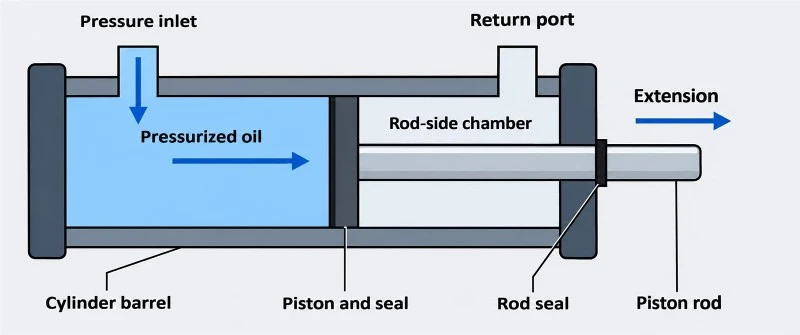
How does a small hydraulic cylinder work?
Hydraulic cylinders operate according to Pascal's law: pressure applied to a confined fluid is transmitted through that fluid.
A typical cylinder contains a barrel, piston, piston rod, end closures, seals, and hydraulic ports. Oil pressure acts on the piston to generate linear force. A single-acting cylinder receives hydraulic power in one direction; a double-acting cylinder receives hydraulic power in both directions.
How to calculate push and pull force
The basic theoretical relationship is:
F = P × A
Where:
- F is force in pounds-force, or lbf.
- P is pressure at the cylinder in psi.
- A is the effective piston area in square inches.
For a conventional single-rod, double-acting cylinder:
Extension force = P × πD² ÷ 4
Retraction force = P × π(D² − d²) ÷ 4
Here, D is the bore diameter and d is the rod diameter.
At the same supply pressure, with negligible return-side pressure, retraction force is lower because the rod reduces the effective piston area. Parker's published selection information uses this distinction when calculating cylinder push and pull forces.
These equations exclude seal friction and opposing pressure. When return-side pressure is significant, calculate the force in each chamber separately:
Net extension force = (cap-end pressure × full piston area) − (rod-end pressure × annular area) − friction
Worked example
Consider a cylinder with:
A 1.5-inch bore.
A 0.75-inch rod.
A supply pressure of 2,500 psi.
Assuming negligible return-side pressure and excluding friction, its calculated forces are:
| Movement | Theoretical force |
|---|---|
| Extension | 4,418 lbf, approximately 19.65 kN |
| Retraction | 3,313 lbf, approximately 14.74 kN |
This is a calculation example, not a specification for a particular DALLAST product. It does not establish the safe lifting capacity of an assembled machine.
Small hydraulic cylinder force comparison
The following extension forces are calculated from full bore area and rounded to the nearest pound-force.
| Bore diameter | At 2,000 psi | At 2,500 psi | At 3,000 psi |
|---|---|---|---|
| 0.75 inch | 884 lbf | 1,104 lbf | 1,325 lbf |
| 1 inch | 1,571 lbf | 1,963 lbf | 2,356 lbf |
| 1.25 inches | 2,454 lbf | 3,068 lbf | 3,682 lbf |
| 1.5 inches | 3,534 lbf | 4,418 lbf | 5,301 lbf |
| 2 inches | 6,283 lbf | 7,854 lbf | 9,425 lbf |
The pressure columns are calculation inputs. Use a value only if the cylinder and every relevant system component are rated for the actual operating conditions.
Pressure ratings and stroke limitations
A compact body does not establish a cylinder's pressure rating. Conventional mobile cylinders and purpose-built lifting cylinders can belong to very different pressure classes.
For example, Enerpac lists its RSM50 low-height lifting cylinder at a maximum operating pressure of 10,000 psi. This is a rating for a dedicated lifting design, not a general rating for small hydraulic cylinders. Enerpac RSM50 specifications.
For compression loads, rod diameter, unsupported length, and mounting conditions determine resistance to buckling. A longer stroke can increase buckling risk when it increases the unsupported rod length. Parker's selection guide treats rod strength as a separate check from bore sizing. Parker hydraulic cylinder selection guide.
Fast or repetitive movement may also require end cushioning or other deceleration controls.
Types of small hydraulic cylinders
Cylinder classifications describe either how the cylinder operates or how it is built. A welded cylinder, for example, can also be double-acting.
| Type | How it works or is constructed | Typical use |
|---|---|---|
| Single-acting | Hydraulic pressure drives one direction; a spring, gravity, or external load provides the return | Simple lifting and clamping |
| Double-acting hydraulic cylinder | Hydraulic pressure drives both extension and retraction | Controlled pushing, pulling, and positioning |
| Telescopic hydraulic cylinder | Nested stages provide a long stroke relative to retracted length | Equipment with restricted installation length |
| Tie-rod | External rods hold the end closures against the barrel | Industrial machinery requiring service access |
| Welded hydraulic cylinder | Welded body construction provides a compact external profile | Mobile, agricultural, and outdoor equipment |
| Compact block | A short body reduces installation length | Tooling, fixtures, and confined machinery |
Choose the operating type according to the required motion. Then select the construction around the available space, mounting arrangement, environment, and maintenance needs.
Mounting, ports, materials, and seals
Match the mounting arrangement to the machine
The mounting arrangement must allow the cylinder to move through its full working range without binding.
| Mounting arrangement | Common application |
|---|---|
| Clevis | Pivoting agricultural attachments and machinery |
| Flange | Presses, fixtures, and fixed industrial assemblies |
| Threaded | Compact mechanical assemblies |
| Foot | Fixed industrial equipment |
| Spherical bearing or rod end | Connections requiring limited angular accommodation |
| Trunnion | Machinery that pivots during operation |
Misalignment creates loads that accelerate rod bearing and seal wear. A spherical bearing can accommodate angular movement within its design limits, but it does not make unrestricted side loading acceptable.
Confirm the exact port connection
Check the thread standard, size, sealing method, orientation, and fitting clearance.
SAE ORB, NPT, and BSPP connections can look similar while using different thread forms or sealing arrangements. Match the complete connection specification before ordering adapters or replacement fittings.
Select materials and seals for the environment
Carbon steel barrels and chrome-plated rods are common industrial choices. Aluminum can reduce weight, while suitable stainless steel grades can improve corrosion resistance.
NBR, polyurethane, and FKM seals have different fluid and temperature capabilities. Select the actual compound for the application rather than choosing by material name alone.
For snowplows and other equipment operating in cold climates, confirm both low-temperature seal performance and the hydraulic fluid's operating viscosity.
How to choose the right small hydraulic cylinder
Start with the load and installation drawing. A cylinder can provide enough theoretical force and still be unsuitable because its retracted length, mounting pins, or port position do not match the machine.
Use this selection checklist:
1.Calculate the maximum required push and pull forces.
2.Establish the pressure available at the cylinder under load.
3.Select a bore that allows for opposing pressure, friction, and the application's design margin.
4.Specify the required stroke and check clearance throughout the movement.
5.Verify rod strength and buckling resistance.
6.Confirm retracted and extended mounting dimensions, pin diameters, and connection details.
7.Match the ports, fitting orientation, pump flow, and required cycle time.
8.Specify the fluid, temperature range, duty cycle, and environmental exposure.
9.Review load control, mechanical support, and equipment safety requirements.
For confined installations, compare overall dimensions as well as stroke. DALLAST's short-stroke hydraulic cylinders are one configuration to consider when only limited travel is needed.
Standard or custom?
A standard cylinder is a practical starting point when its bore, stroke, pressure rating, and mounting dimensions match the equipment.
A custom design becomes useful when the installation requires unusual mounting distances, dedicated connection interfaces, a nonstandard stroke, corrosion-resistant materials, or a particular seal arrangement.
For an OEM project, ask whether an existing cylinder design can be adapted before commissioning an entirely new design. Confirm the proposed dimensions and operating limits on the approval drawing.
Typical applications
| Application | Cylinder function |
|---|---|
| Snowplows | Blade angling and positioning |
| Lifting platforms | Raising and lowering |
| Agricultural machinery | Implement and attachment adjustment |
| Workshop presses | Pressing and assembly |
| Vehicle tail lifts | Loading and unloading assistance |
| Industrial automation | Clamping and component positioning |
Other applications include compact log splitters, garden machinery, recreational vehicles, accessibility equipment, and specialized OEM machinery.
The application name alone does not establish suitability. Lifting and accessibility equipment require particular attention to load control and the consequences of component failure.
Hydraulic or pneumatic?
| Consideration | Hydraulic cylinder | Pneumatic cylinder |
|---|---|---|
| Working medium | Hydraulic fluid | Compressed air |
| Force within a limited space | Generally higher | Generally lower |
| Positioning stiffness | Generally higher | Lower because air is compressible |
| Movement | Depends on flow and controls | Often suited to rapid cycling |
| Load holding | Requires suitable hydraulic controls | Also requires appropriate control measures |
| System requirements | Pump, reservoir, valves, filtration, and piping | Air supply, valves, air preparation, and piping |
| Maintenance | Fluid condition, filtration, and seals | Air quality and seals |
Hydraulics are often suitable when substantial force must fit into a compact installation. Pneumatics can suit lighter loads and rapid repetitive movement. Where cleanliness matters, assess the complete system, including possible oil leakage or lubricant carried in compressed air.
Maintenance and common problems
Routine checks should cover fluid condition, filtration, rod surfaces, mounting connections, and external leakage. Follow the equipment manufacturer's service intervals and replace seals according to their condition and the approved maintenance procedure.
Protect exposed rods against corrosion during storage. Remove trapped air only through the manufacturer's specified bleeding procedure.
When replacing seals, confirm the cylinder model, groove dimensions, seal profile, material, and fluid compatibility. DALLAST's small hydraulic cylinder seal kit guide provides related information for this part of the maintenance process.
| Symptom | Possible causes | Diagnostic focus |
|---|---|---|
| Oil around the rod | Worn rod seal, damaged rod surface, or contamination | Inspect the rod and sealing assembly |
| Oil around a port | Damaged connection seal, incorrect fitting, or loose connection | Check the specified connection after isolation and depressurization |
| Load drift | Cylinder leakage or leakage elsewhere in the circuit | Check the cylinder, control valve, and load-holding components |
| Slow movement | Restricted flow, internal leakage, or pump problems | Check pressure and flow under the specified test conditions |
| Jerky movement | Trapped air, friction, or misalignment | Review bleeding, lubrication, and alignment |
| Excessive heat | Leakage or excessive pressure losses | Investigate the hydraulic circuit |
| Bent rod | Overload, buckling, or side loading | Review sizing, guidance, and mounting |
Load drift alone does not prove that the piston seal has failed. A qualified technician should follow the equipment manufacturer's diagnostic procedure to distinguish cylinder leakage from valve or circuit problems.
Safety when using or servicing a small hydraulic cylinder
Never exceed the cylinder's rated working pressure. Hoses, fittings, valves, mountings, and connected structures must also suit the actual operating conditions.
Before servicing:
- Isolate the equipment's energy sources.
- Control stored pressure and verify the isolation.
- Secure raised loads with appropriate mechanical supports.
- Keep clear of moving parts and pinch points.
- Never loosen a pressurized hydraulic connection.
- Never use bare hands to search for a hydraulic leak
High-pressure fluid can penetrate the skin. Suspected fluid injection requires immediate professional medical treatment, even when the visible wound appears small. The UK Health and Safety Executive describes this hazard in its hydraulic injection injury alert.
For U.S. workplaces covered by OSHA's general industry lockout/tagout standard, servicing procedures must address hazardous stored energy and verify isolation before work begins.
What affects small hydraulic cylinder cost?
Price depends on the bore, stroke, rod dimensions, pressure rating, materials, machining requirements, seals, order quantity, customization, and testing.
Compare maintenance requirements as well as purchase price. Replacement seal availability, repair labor, and equipment downtime can affect the cost of keeping the cylinder in service.
Before a bulk order, confirm the approved drawing, inspection and testing requirements, delivery terms, spare parts, and after-sales arrangements.
Specifying a small hydraulic cylinder with DALLAST
DALLAST lists miniature hydraulic cylinders and customization options for compact installations.
For a selection review or quotation, provide the required force, available pressure, bore and rod dimensions if known, stroke, mounting details, and installation drawing. Include the fluid, temperature range, duty cycle, and whether the cylinder must support or control a raised load.
For a replacement cylinder, send the existing model information and measured connection dimensions. For a new machine, include the load and movement requirements so the proposed configuration can be checked before manufacture.Request a custom hydraulic cylinder quote.
Frequently asked questions
What is the smallest hydraulic cylinder available?
There is no single minimum size across all manufacturers. Miniature cylinders with bores around 10 mm are commercially listed, including designs for RC models. Suitability depends on the cylinder's verified pressure rating, construction, duty cycle, and intended use.
When should I choose a pneumatic cylinder instead?
Consider pneumatics for lighter loads and rapid repetitive motion when compressed air is available. Consider hydraulics when greater force is required within a restricted space. Compare the complete systems, including controls, maintenance, and load-holding requirements.
How can I tell whether my cylinder has an internal leak?
Possible symptoms include reduced force, abnormal heat, slow movement, and unexpected drift. Valve and pump problems can produce similar symptoms. Diagnosis requires an approved test procedure that separates cylinder performance from the rest of the circuit.