

Small hydraulic ram supplier: How to choose the right manufacturer for your application
Choosing a small hydraulic ram supplier starts with the equipment the cylinder will operate. The ram needs to fit the available space, produce the required force at the system's working pressure and transfer that force safely through its mountings.
Small hydraulic rams are used in compact machinery, industrial clamps, workshop presses, automotive repair tools and lifting equipment. Similar dimensions do not make two cylinders interchangeable. Pressure ratings, return mechanisms, port connections and load conditions can differ substantially.
Give each prospective supplier the same application details and drawings. Their ability to review those requirements, document the proposed design and support it after delivery provides a useful basis for comparison.
Build a shortlist around manufacturing capability and service
Establish who makes and supports the product
A supplier may manufacture cylinders, distribute another company's products or arrange production through a separate factory. These roles can overlap. OEM and ODM services describe how a supplier works with customers, rather than a separate category of manufacturer.
A direct manufacturer may offer more flexibility for custom dimensions, mounting arrangements and production quantities. Ask which processes it performs in-house, which it outsources and who takes responsibility for the finished cylinder.
A distributor may be a practical choice when local stock, small orders or domestic returns matter most. Confirm actual inventory and support arrangements for the model you need.
For either route, establish who handles drawing approval, product testing, warranty claims and replacement parts.
Verify the evidence behind supplier claims
Before placing a supplier on your shortlist:
Confirm its legal name, business registration and manufacturing location.
Request relevant quality certificates and check their scope, validity and issuing body.
Review machining, assembly and inspection evidence, including factory audit reports where available.
Ask the engineering team to review your drawing and identify pressure, mounting or material concerns.
Obtain a realistic production schedule and an explanation of how delays are communicated.
Confirm the available technical support, service parts and warranty process.
ISO 9001 certification concerns an organization's quality management system. It does not certify the performance of an individual hydraulic ram. Check the certificate alongside the technical records for the product you intend to buy.
Ask about CE-related conformity requirements where they apply to the specific product and destination market. A general statement about certification should be supported by documents identifying the relevant product and requirements.
For DALLAST, its company profile describes hydraulic cylinder design, manufacturing and inspection activities. Buyers can also review its certificate page, then request complete, current documents for verification. Treat these pages as supplier information to investigate during qualification.
A shortlist of three to five suppliers is usually enough for a structured comparison. Evaluate technical responses, documentation, delivery arrangements and total purchasing cost alongside the unit price.
Confirm force, pressure, dimensions and mounting
Terms such as "compact" and "high-force" are too broad for a purchase specification. A supplier needs measurable requirements to recommend a cylinder.
Specifications to include in your RFQ
| Specification | What to confirm |
|---|---|
| Required force | Push or pull force in kN, lbf or a clearly defined ton-force unit |
| Bore diameter | Internal cylinder diameter, where already specified |
| Piston rod diameter | Rod dimensions and suitability for the intended load |
| Stroke | Required travel distance |
| Retracted length | Closed overall length or mounting-center distance, using agreed reference points |
| Extended length | Full-extension dimensions and available clearance |
| Working pressure | Rated operating pressure in psi, bar or MPa; identify test pressure separately |
| Operating type | Single-acting or double-acting; specify the return method for single-acting models |
| Mounting | Threaded body, clevis, flange, base or another defined arrangement |
| Ports | Thread standard, size, position and fitting compatibility |
| Materials and finish | Body material, rod coating and corrosion protection |
| Operating conditions | Temperature, hydraulic fluid, duty cycle and environment |
If bore or rod dimensions have not been selected, provide the load requirements and installation limits so the supplier can propose a design. Avoid filling gaps with dimensions taken from a visually similar cylinder.
Understand how force and pressure relate
For a conventional cylinder, the simplified theoretical relationship is:
Force = hydraulic pressure × effective piston area
A larger bore produces more theoretical extension force at the same pressure. Actual output also depends on friction and circuit backpressure, while the allowable load remains limited by the cylinder's construction and installation.
For a conventional single-rod, double-acting cylinder, theoretical retraction force is lower than extension force at the same applied pressure because the rod reduces the effective area.
Request both rated force and rated working pressure. A tonnage description alone does not establish compatibility with your pump.
DALLAST's has mini hydraulic ram specifications, for example, list a working pressure of 2 to 5 MPa. This is a specification for that product reference, rather than a pressure range for all small hydraulic rams.
A 10,000-psi workshop system requires components rated for that system. Confirm the ordered cylinder's working pressure against the pump and circuit requirements, and keep working-pressure and test-pressure figures separate.
Choose the operating type for the required movement
A single-acting ram uses hydraulic pressure for movement in one direction. A spring, gravity or another external force provides the return movement. Spring-return is therefore a type of single-acting arrangement.
A double-acting cylinder uses hydraulic pressure for both extension and retraction.
Single-acting models can suit pushing operations with an appropriate return mechanism. Double-acting models provide powered movement in both directions, which may be required for machinery operation.
DALLAST's single-acting and double-acting cylinder range provides a starting point for comparing configurations. Confirm which arrangement is available for the particular miniature or compact model under consideration.
Review the complete installation
Mounting determines how the cylinder transfers force into the machine. Threaded bodies can suit compact fixtures, while clevis and pivot mounts accommodate suitable applications involving angular movement. Base-mounted designs may suit axial pressing loads.
Ask the supplier to check alignment, mounting loads and rod stability at the required stroke. Installation dimensions alone cannot establish whether a cylinder is suitable for the load.
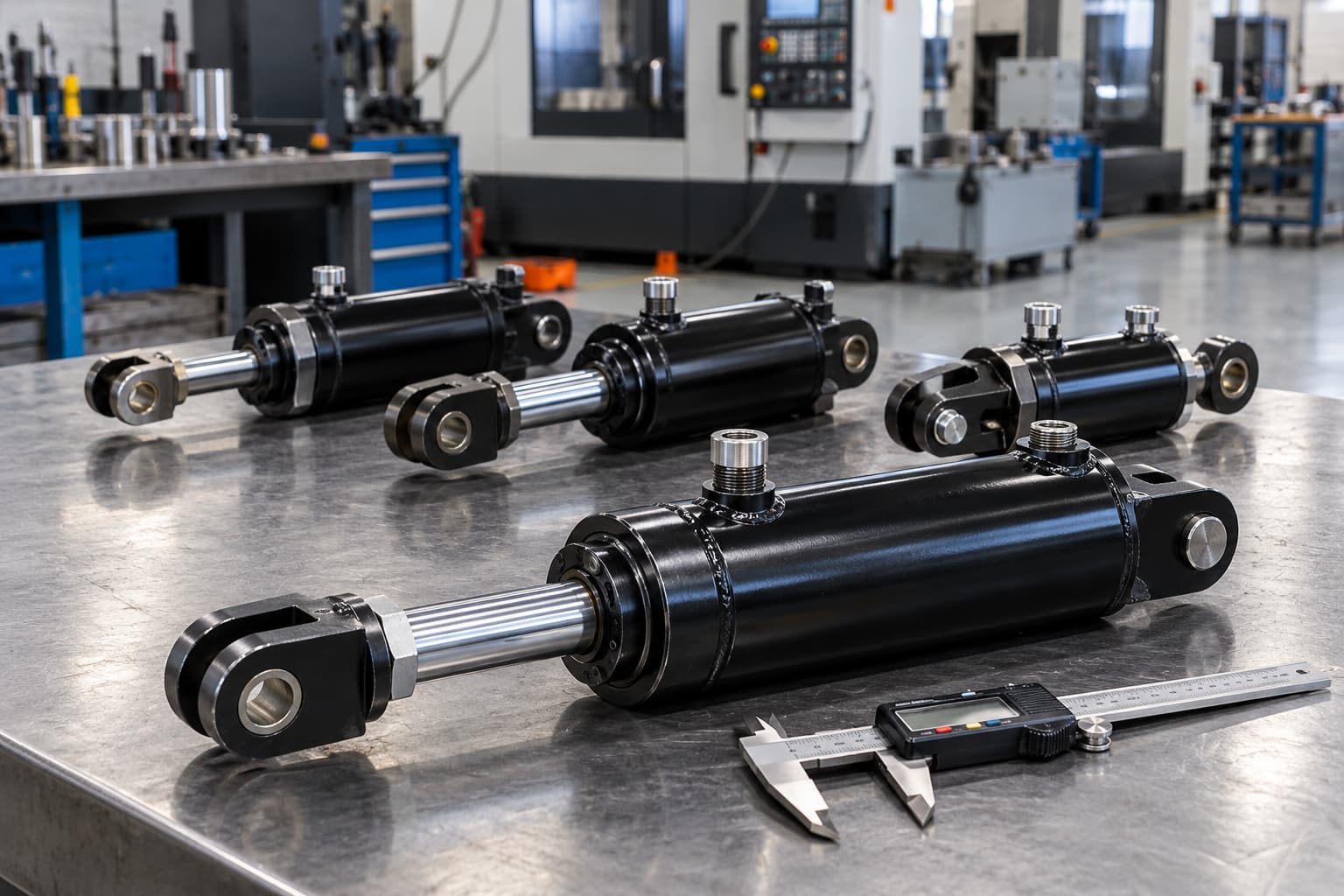
Confirm compatibility among the cylinder, pump, hoses, couplers, fittings and valves. Pressure protection must keep each component within its rating. For lifting work, never rely on hydraulic pressure alone to support a raised load. Use suitable mechanical supports and follow the equipment manufacturer's instructions.
Compare quotations using the same requirements
A request for the "price of a small hydraulic ram" leaves too much open to interpretation. Send every shortlisted supplier the same specification sheet, drawing revision, quantity and delivery destination.
For replacement parts, include the existing part number, photographs and dimensioned drawings where available. Identify which dimensions and connections must remain unchanged.
If relevant to your purchasing plan, request prices for quantities such as 1, 10, 50 and 100 units.
Clarify MOQ, samples and production timing
Minimum order quantities depend on the design, materials, machining and production setup. A supplier's willingness to accept a small order for one model does not establish the MOQ for another.
Ask the quotation to state:
MOQ for the standard model and for a custom version.
Whether a single prototype is available and what it costs.
Unit prices at the requested quantities.
Engineering, tooling and setup charges.
Whether prototype charges can be credited against a production order.
Separate schedules for drawing approval, prototype completion, production and shipment.
Custom prototypes may require material procurement, machining, assembly and testing after drawing approval. For repeat orders, ask whether the approved design and available materials allow a shorter schedule.
Confirm when each quoted lead time begins. A production estimate that starts after drawing approval is different from a delivery commitment measured from the purchase order date.
Calculate total landed cost
Use a common cost breakdown when comparing domestic and imported options.
| Cost component | What to verify |
|---|---|
| Unit price | Price for the agreed specification and quantity |
| Tooling and setup | One-time charges and ownership arrangements |
| Inspection | Included tests and charges for additional requirements |
| Packaging | Cartons, crates, pallets and export protection |
| Freight | Courier, air, sea or domestic delivery charges |
| Import costs | Applicable duties, taxes and brokerage |
| Expedited service | Charges for accelerated production or shipping |
For international purchases, identify the agreed shipping rule, named place or port, and applicable Incoterms edition. If a quotation uses EXW, FOB, DAP or DDP, confirm the associated transport and customs responsibilities. FOB is a sea and inland-waterway rule, so the term must suit the shipping method.
Have a qualified customs broker confirm the tariff classification and current import charges before finalizing landed-cost estimates.
Agree on payment milestones separately, particularly for custom or nonreturnable products. Record what must be completed or approved before each payment becomes due.
Evaluate customization against the application
A standard ram may not fit equipment with limited space, unusual mounting geometry or specific operating requirements. A custom design can address those constraints, subject to engineering review.
Typical requests include changes to stroke and closed length, mounting brackets or clevis ends, port positions, seal materials and surface treatments. OEM identification, branding and packaging should be discussed separately.
Before production, approve a technical drawing that identifies critical dimensions, tolerances, materials, pressure requirements and mounting details. Also agree on the inspection methods and acceptance criteria.
DALLAST lists standard and custom designs within its small hydraulic cylinder range. Confirm the proposed configuration, feasibility and order requirements in the quotation and approved drawing. Private-label options should be confirmed rather than assumed.
Match the selection process to the job
| Application | Selection priorities |
|---|---|
| Automotive body repair | A rated push or pull cylinder compatible with the repair system |
| Workshop press | Axial load capacity, stability, mounting and press-frame compatibility |
| Lifting and positioning | Load rating, installation space and mechanical load-support arrangements |
| Industrial clamping | Controlled force, compact dimensions and repeatable operation |
| Compact machinery | Mounting geometry, hydraulic circuit integration and duty cycle |
Small hydraulic ram, bottle jack or portable repair cylinder?
These labels describe different product arrangements, although their functions can overlap.
A small hydraulic ram is an actuator that produces linear force within a compatible hydraulic system. It may be built into machinery or supplied as part of a tool.
A bottle jack is typically a self-contained lifting device with its own pumping mechanism. It can suit approved lifting applications but is generally less convenient to integrate into machinery.
A porta-power-style repair cylinder works with a compatible external pump and hose. Such cylinders are commonly used in portable pushing, spreading and repair systems.
Choose according to the required force, operating pressure, movement direction, portability and installation method. Confirm system compatibility even when two cylinders have similar external dimensions.
Check service parts, warranty and repair documentation
A replacement cylinder can be inexpensive to purchase yet costly to maintain if its seals or identifying records are unavailable. Establish the service arrangements before ordering.
Ask about parts for the exact model
Request information on replacement seals, wipers, wear rings, rod components and other serviceable parts. Confirm whether the selected cylinder can be serviced or rebuilt and what documentation is available.
For custom cylinders, ask how future replacement parts will be identified and whether seal specifications will remain available for repeat orders.
DALLAST's hydraulic cylinder parts range includes tubes and rods. Availability of those components does not establish that a complete seal kit is available for a particular miniature ram. Ask for model-specific part references and supply arrangements.
Put warranty and return terms in writing
Obtain clear answers to these questions:
How long is the warranty, and when does coverage begin?
Which manufacturing defects are covered?
How are seals, wear parts and installation-related damage treated?
What photographs, test records or other evidence are needed for a claim?
Who pays return freight?
Can a custom cylinder be returned, repaired or replaced?
Is rebuilding support available, and what turnaround can be quoted?
Record the agreed terms in the purchase documents. Avoid relying on a general website statement when the order requires a specific support commitment.
Request the records needed for installation and maintenance
Useful documentation includes:
Approved dimensional drawings.
Operating and installation instructions.
Agreed pressure and leakage test reports.
Product and component identification.
Maintenance procedures.
Available service-parts or rebuild information.
Confirm which records are included with the order and whether test reports identify the supplied model or unit. Clear documentation helps maintenance teams order the correct replacement and install it according to the manufacturer's requirements.
Frequently asked questions
How can I tell whether a supplier manufactures hydraulic rams or distributes them?
Ask who performs machining, assembly and testing, and where those activities take place. Check the legal entity, factory information and production records. For a distributor, confirm the original manufacturer and who handles technical support and warranty claims.
What should I include in a request for quotation?
Provide required force, working pressure, stroke, mounting dimensions, port details, operating type, quantity and destination. Include bore and rod dimensions where specified, together with retracted and extended lengths. A dimensioned drawing helps reduce interpretation errors.
What MOQ and lead time should I expect?
Both depend on the exact design, stock position, materials and order quantity. Request separate written confirmation for prototypes and production orders, including the point from which the quoted lead time begins.
Can a manufacturer customize the stroke, mounting or ports?
Many manufacturers offer these changes, subject to engineering feasibility. Provide the load requirements and installation constraints, then approve the proposed drawing and acceptance criteria before production.
What after-sales support should I confirm?
Check model-specific seal and service-parts availability, warranty coverage, return authorization, freight responsibilities and repair options. For custom orders, obtain clear product identification and available maintenance documentation.
Should I buy from a U.S. supplier or import directly?
A U.S. supplier may be practical when confirmed local stock, domestic returns and small quantities are priorities. Direct importing may suit custom designs or repeat production. Compare the actual landed cost, inspection arrangements, delivery schedule and support responsibilities for each option.
How does a small ram compare with a bottle jack or porta-power-style cylinder?
A small ram is an actuator used within a compatible hydraulic system. A bottle jack is typically a self-contained lifting tool, while a porta-power-style cylinder uses an external pump for portable repair work. Select the equipment according to its intended application, pressure rating, force and installation requirements.