

Selecting a hydraulic equipment supplier is not simply a matter of comparing catalogs and choosing the lowest quotation. For OEMs, distributors, equipment builders, maintenance teams, and industrial buyers, the supplier can directly affect equipment reliability, production uptime, maintenance costs, and long-term spare-parts availability.
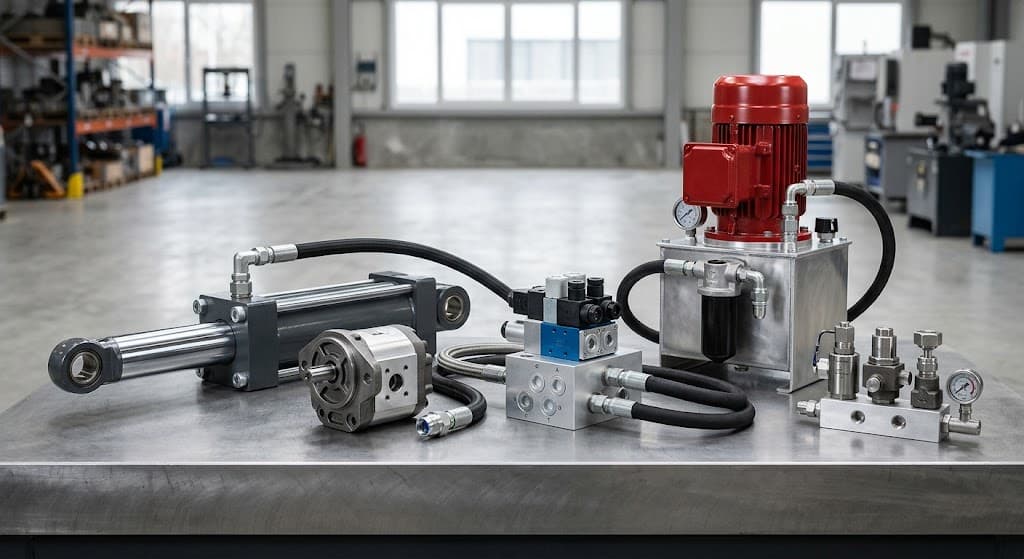
A qualified supplier should be able to demonstrate not only what its equipment is designed to do, but also how that performance is verified, how quality is controlled, how replacement parts are supported, and what happens when equipment does not meet agreed specifications.
Whether you are purchasing complete hydraulic systems, pumps, valves, power units, or working with a hydraulic cylinder manufacturer the following evaluation process can help reduce procurement risk before a purchase order is issued.
1. Evaluate Product Quality, Reliability, and Technical Fit
Start with the application, not the supplier's catalog.
A product may meet the required pressure, flow, bore, stroke, or load rating on paper while still being poorly suited to the actual duty cycle, operating environment, mounting arrangement, contamination level, or control system.
Before sending an RFQ, define the actual operating conditions. These should include working and peak pressure, load, duty cycle, operating temperature, hydraulic fluid, cycle frequency, installation space, environmental exposure, required service life, and interfaces with existing equipment.
For cylinder applications, buyers should also understand the differences among single and double acting hydraulic cylinders, telescopic cylinders, welded cylinders, tie-rod cylinders, and other designs before evaluating quotations.
Do not rely only on rated specifications. Ask the supplier for evidence showing how the product performs in production or field conditions.
| Verification Item | What to Request |
|---|---|
| Material quality | Material Test Reports (MTRs), material grade and batch traceability |
| Pressure capability | Proof-pressure and leakage test records |
| Reliability | MTBF or documented service-life information where available |
| Field performance | Failure rate, uptime or maintenance records from comparable applications |
| Manufacturing quality | Machining tolerances, welding procedures, surface-finish requirements |
| Inspection | Dimensional, pressure, coating and final inspection records |
| References | Comparable customer applications and references where disclosure is permitted |
Field references can be particularly valuable. Instead of asking, "Are your products reliable?", ask reference customers how long the equipment has been operating, what failures occurred, how often replacement parts were needed, and how quickly the supplier responded when a problem appeared.
Technical compatibility should also be reviewed before price negotiation. Check hydraulic ports, mounting dimensions, electrical interfaces, sensors, control signals, communication requirements and available installation space.
When replacing an existing cylinder, accurate dimensions are especially important. A buyer can use a hydraulic cylinder measurement guide to document bore, rod diameter, stroke, closed length, mounting centers, pin sizes and port specifications before requesting a replacement.
A technically strong supplier should be willing to review drawings and application data rather than simply quote the nearest catalog model.

2. Verify Certifications, Compliance, and Testing Protocols
Certifications should be treated as documents to verify, not logos to collect.
As of September 2026, ISO 9001:2026 is the current edition of the ISO quality-management-system standard. Because the new edition was only released on September 16, 2026, some certified organizations may still be working through the transition process established by their certification bodies. Buyers should therefore check the exact standard edition, certification scope, certificate number, issuing organization and validity rather than accepting a generic "ISO certified" statement.
The required technical standards depend on the equipment being purchased.
ISO 4401:2005, for example, specifies mounting surfaces for four-port hydraulic directional control valves to support interchangeability.
Fluid cleanliness is another area where terminology is often confused. ISO 4406:2021 defines the coding method for solid-particle contamination levels in hydraulic fluids, while ISO 11171:2022 concerns calibration of automatic particle counters used to make particle measurements.
For equipment containing qualifying pressure vessels or accumulators, applicable ASME Boiler and Pressure Vessel Code requirements should also be reviewed. ASME Section VIII provides requirements covering design, fabrication, inspection, testing and certification for pressure vessels within its scope.
In petroleum, petrochemical and process applications, pump requirements may also reference API standards. API 610 covers centrifugal pumps, API 674 covers reciprocating positive-displacement pumps, and API 676 covers rotary positive-displacement pumps. The correct standard depends on the actual equipment and industry rather than the fact that the system is hydraulic.
Electrical components may require certification by an OSHA-recognized Nationally Recognized Testing Laboratory (NRTL), depending on the product and workplace application. OSHA explains that properly certified products bear the certification mark of the applicable recognized laboratory and must fall within that laboratory's recognized scope.
Before approving a supplier, verify certificate numbers, scope and expiration or transition status; request laboratory or inspection reports where relevant; match MTR heat or batch numbers to supplied materials; establish sampling requirements; and define measurable acceptance criteria before production begins.
"Tested before shipment" is not enough. The quotation or quality agreement should state what is tested, how it is tested and what constitutes a pass or failure.
3. Assess After-Sales Service, Spare Parts, and Lead Times
A low purchase price can become expensive when a $20 seal, sensor, valve, fitting or replacement assembly causes several days of equipment downtime.
Evaluate after-sales support with measurable service indicators rather than statements such as "24-hour service" or "excellent after-sales support."
Ask suppliers for typical spare-parts fill rate, standard spare-parts lead time, emergency response time, warranty response process, typical repair turnaround, technical-support availability and recommended spare-parts packages.
For critical equipment, classify replacement parts into three groups.
Critical spares can stop the machine or production line if they fail. Operational spares affect performance but may allow limited operation. Routine consumables include filters, seals and other predictable maintenance items.
The supplier should help determine which components belong in each category.
A spare-parts agreement can also define a minimum stocking commitment. For example, a supplier may agree to maintain selected seal kits, valves, sensors or high-risk components for a defined period after equipment delivery.
Warranty terms require the same level of detail.
Clarify when the warranty starts, what parts and labor are included, who pays freight, whether field service is covered, what constitutes misuse, and how quickly the supplier must respond to a claim.
For important installations, use an SLA with measurable targets such as acknowledgment of a critical service request within an agreed period, remote technical support within a defined window, emergency spare-part dispatch targets, and escalation contacts.
These targets should reflect the real operational risk of the project rather than an arbitrary "48-hour" promise.
Also evaluate supplier continuity. A customized hydraulic component that cannot be supported three years later creates a different risk from a standardized component with documented drawings, seal specifications and interchangeable parts.
4. Use Supplier Audits, RFQs, FATs, and Contract Controls
A structured procurement process makes competing quotations much easier to compare.
Your RFQ should provide the same operating data and acceptance requirements to every supplier. If Supplier A quotes a cylinder for 2,500 psi continuous pressure while Supplier B assumes 3,500 psi, the two prices are not directly comparable.
For cylinder projects, review the available types of hydraulic cylinders and define the required construction, mounting, pressure, stroke and environmental conditions before requesting quotations.
A supplier scorecard can then compare vendors across the same criteria.
| Evaluation Area | Example Weight |
|---|---|
| Technical compliance | 25% |
| Quality system and testing | 20% |
| Manufacturing capability | 15% |
| Delivery performance | 10% |
| Spare parts and service | 10% |
| Commercial terms | 10% |
| References and project experience | 10% |
The percentages are only an example. A safety-critical or highly customized project may assign more weight to engineering and quality and less to purchase price.
For significant orders, conduct a factory audit either directly or through an independent inspection company. Review incoming material control, traceability, welding, machining, calibration records, assembly, pressure testing, nonconformance control and final inspection.
A Factory Acceptance Test should then confirm agreed performance before shipment. Depending on the equipment, the FAT may cover dimensions, pressure, leakage, function, controls, safety devices, noise, temperature, flow, cycle time or other project-specific criteria.
For complex systems, a Site Acceptance Test can verify performance after installation.
Commercial risk can be reduced through milestone payments rather than full payment before final acceptance. A typical structure may connect payments to order confirmation, completion of manufacturing, successful FAT and final delivery or commissioning.
For higher-risk projects, contracts may also include performance guarantees, spare-parts commitments, documentation requirements and clearly defined remedies for nonconforming equipment or major schedule delays.
5. Compare Price, Lead Time, Logistics, Installation, and TCO
Purchase price should be compared only after technical scope has been normalized.
The lowest quotation can become the most expensive option if it has a shorter service life, longer repair cycle, expensive proprietary spares or poor delivery reliability.
Calculate Total Cost of Ownership rather than initial equipment cost alone:
TCO = Purchase Price + Freight + Duties + Installation + Commissioning + Maintenance + Spare Parts + Energy + Expected Downtime Cost − Residual Value
Downtime should not be ignored.
For example, consider an illustrative U.S. manufacturing operation where a hydraulic system supports equipment generating $3,000 of contribution value per production hour.
Supplier A costs $8,000 less initially but is expected to create 12 additional hours of downtime during its operating period.
Potential downtime impact:
12 hours × $3,000/hour = $36,000
The apparent $8,000 saving could therefore expose the buyer to substantially greater operational cost.
This is an illustrative calculation, not a Dallas Hydraulics customer-performance claim. Real ROI calculations should use the buyer's actual downtime cost, failure history and maintenance data.
Lead time should also be separated into engineering approval, material procurement, manufacturing, testing, transport, customs where applicable, installation and commissioning.
For urgent projects, compare the cost of expedited air freight or priority production with the financial effect of delayed commissioning.
Installation scope must also be defined. Determine whether the supplier provides mechanical installation, hydraulic piping, electrical connection, flushing, oil cleanliness verification, pressure adjustment, control setup, startup testing and operator or maintenance training.
Financing and payment terms should be compared alongside price. Deposits, progress payments, letters of credit, net terms and equipment-financing options can materially affect project cash flow.
Build a Supplier Qualification Process Before You Request a Quote
The most effective supplier selection process begins before quotations arrive.
Prepare one technical specification, one RFQ format and one acceptance standard so every supplier is evaluated against the same requirements.
For hydraulic cylinder projects, provide application, load, pressure, bore, rod diameter, stroke, mounting dimensions, ports, operating environment, quantity and drawings where available.
Then request supporting quality documentation, manufacturing and inspection information, target lead time, warranty conditions and recommended spare parts together with the quotation.
This turns procurement from a price comparison into a controlled engineering and supply-chain decision.
Request a Quote: Send your drawings, dimensions, operating pressure and application requirements for a technical review and quotation.
Request a Factory Audit: Ask to review manufacturing, quality-control and testing capabilities before placing a major order.
Request Sample or Prototype Testing: For customized or high-volume projects, define prototype test criteria before approving bulk production.
Frequently Asked Questions
What certifications and documentation should I require from a hydraulic equipment supplier?
Requirements depend on the product and application. Common documentation can include the supplier's applicable ISO quality-management certification, MTRs, drawings, pressure-test reports, inspection records, welding documentation, electrical certifications and project-specific compliance records. Verify the certificate number, issuing body, scope, edition and current status rather than relying on a logo.
How can I evaluate spare-parts availability before signing a contract?
Ask for a recommended spare-parts list, current stock availability, normal replenishment lead time, emergency dispatch capability and historical fill-rate data if available. For critical equipment, place minimum-stock commitments in the supply agreement.
What should be included in a hydraulic equipment RFQ?
Include the application, working and peak pressure, required flow, load, duty cycle, fluid, temperature, environmental conditions, interfaces, dimensions, materials, standards, quantity, testing requirements, documentation requirements, delivery destination and acceptance criteria.
How do I calculate hydraulic equipment TCO?
Combine acquisition, shipping, installation, commissioning, energy, maintenance, spare parts and expected downtime costs over the planned operating period. Compare suppliers using the same assumptions and time horizon.
What should I inspect during a hydraulic supplier factory audit?
Review material traceability, machining, welding, calibration, assembly, cleanliness, pressure testing, inspection records, nonconformance management and final packaging. Confirm that documented procedures are actually followed on the production floor.
How should warranties and SLAs be structured?
Define warranty duration, covered components, exclusions, freight responsibility, response targets, repair or replacement procedures and escalation contacts. For critical equipment, attach measurable service levels instead of relying on general support promises.
What delivery, installation, and commissioning support should a supplier provide?
The required scope depends on the project, but it may include shipping coordination, installation guidance, hydraulic connections, flushing, electrical or control integration, startup testing, operator training, maintenance training and final acceptance documentation.