

China hydraulic cylinder factory: How buyers should assess manufacturers, pricing, quality, and lead times
Sourcing hydraulic cylinders from China can lower manufacturing costs and give buyers access to custom machining, telescopic designs, welded cylinders, and OEM production capacity. The suppliers behind a search for "China hydraulic cylinder factory" vary widely, though. Some run highly automated OEM plants; others are small workshops or trading companies that outsource most critical processes.
A qualified factory should show where machining, honing, welding, assembly, testing, and surface treatment take place. It should also provide controlled drawings and inspection records, explain its production capacity, and show how the proposed cylinder meets the buyer's requirements for pressure, mounting, seals, operating environment, and interfaces.
DALLAST manufactures and customizes hydraulic cylinders in China, including single-acting, double-acting, telescopic, construction, agricultural, dump-truck, and industrial models. Its industrial hydraulic cylinder range gives OEM buyers a starting point for reviewing products. The checks below can help buyers assess the manufacturing claims behind those products.
How to assess Chinese hydraulic cylinder manufacturers
Website figures are a starting point. During an audit, verify the legal company name, business license, factory address, and current ISO certificate. Check machine ownership, calibration records, staffing shifts, subcontracted processes, monthly output records, and production bottlenecks.
Honing, chrome plating, welding, and testing deserve close attention. A factory with dozens of CNC lathes may still depend on one honing machine or one pressure-test station. That operation can limit the output of the entire line.
For a remote audit, arrange a live video walkthrough. Ask the supplier to move from incoming material storage through machining, welding, assembly, inspection, and finished-goods areas, showing machine nameplates and current work orders along the way. Edited factory footage alone gives buyers less to check.
For larger sourcing programs, commission an independent audit by SGS, Bureau Veritas, or a comparable organization. Request at least two customer references that the customers have authorized the supplier to share.
Product specifications, CAD files, and test data
An OEM quotation needs enough detail to establish whether the cylinder will work in the intended application. Bore, stroke, and working pressure alone are insufficient.
Request a controlled technical data package for each cylinder:
| RFQ or drawing item | What the buyer should receive |
|---|---|
| Cylinder configuration | Single-acting or double-acting; welded, tie-rod, or telescopic construction |
| Bore, rod, and stroke | Exact dimensional tolerances as well as nominal values |
| Working and test pressure | Rated pressure and an agreed proof-test procedure |
| Barrel material | Material grade and traceability through an MTC or MTR |
| Rod material | Grade, heat treatment, and hardness |
| Rod coating | Chrome or alternative coating, thickness, and surface finish |
| Seals | Material, manufacturer and profile where critical, temperature range, and fluid compatibility |
| Mounting | Clevis, flange, trunnion, pin eye, or custom interface |
| Ports | SAE, NPT/NPTF, ORB, BSPP, or metric, as specified |
| CAD files | PDF/DWG drawings plus STEP or another agreed 3D format |
| Quality records | Dimensional report, pressure and leak-test results, and batch identification |
For a custom project, the single and double acting hydraulic cylinder category can help buyers identify a product type. Put the actual acceptance specifications on the approved drawing.
Specifications need to be checked at the model level. For example, one DALLAST tractor/trailer cylinder page lists materials including 27SiMn, ST52, CK45, E355, E470, and 42CrMo4, a pressure range of 9-23 MPa, multiple seal brands, and chrome thickness of 25-30 µm. A separate front-end telescopic cylinder page lists working pressure up to 220 bar and test pressure of 280 bar for that product family. Neither set of figures applies automatically to every DALLAST cylinder.
For a custom project, the single and double acting hydraulic cylinder category can help buyers identify a product type. Put the actual acceptance specifications on the approved drawing.
The buyers should also confirm imperial mounting dimensions, pin fits, SAE port requirements, hose clearance, U.S. seal availability, and interchangeability with existing service parts.
Where fatigue life, salt exposure, or safety-critical service matters, request the raw test report. A statement that a cylinder was "fatigue tested" or "salt-spray tested" leaves too much unspecified.
Pricing, minimum orders, and lead times
Cylinder prices depend on bore, stroke, pressure, order quantity, machining complexity, rod coating, seals, and testing requirements. Public sourcing references for 2026 give the following approximate FOB China ranges for budgeting:
| Cylinder type | Indicative FOB range |
|---|---|
| Agricultural, roughly 40-100 mm bore | $50-$300 |
| Construction machinery, roughly 80-250 mm | $200-$1,500 |
| Telescopic dump/tipper cylinders | $300-$3,000 |
| Industrial press or heavy-duty custom cylinders | $500-$5,000+ |
The cylinder price is only part of the budget. Allow separately for engineering and non-recurring engineering charges (NRE), special tooling, premium seals, third-party inspection, destructive testing, expedited material, packaging, freight, customs duties, and inland delivery.
Before comparing a $180 quotation with a $260 quotation, confirm that both cover the same drawing revision, material grade, coating thickness, seal package, factory acceptance test (FAT) procedure, and Incoterm.
OEM/ODM customization and quality control
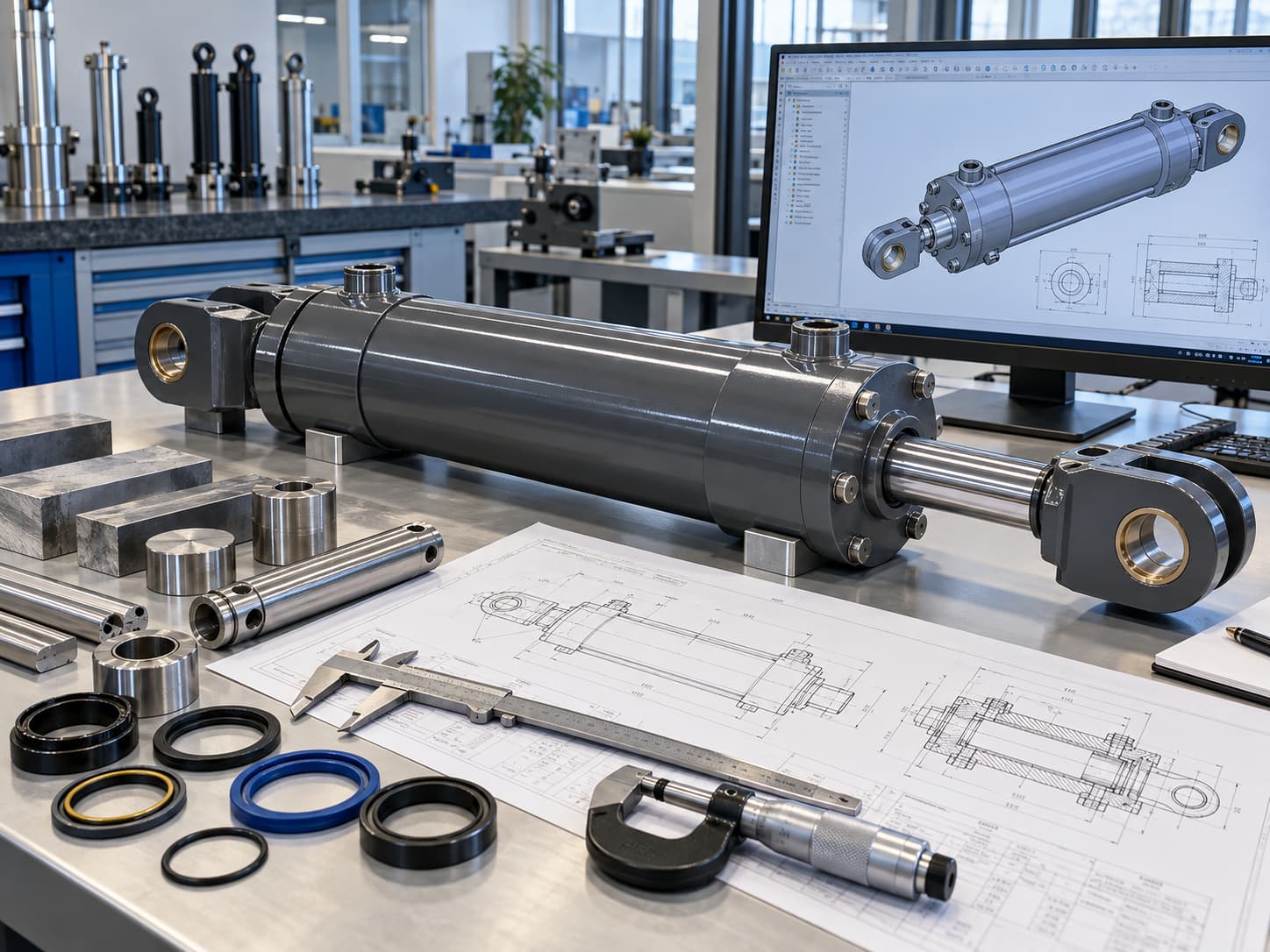
A controlled OEM program follows a defined approval sequence:
RFQ and application review → controlled drawing → material and seal approval → prototype → dimensional and functional validation → first-article approval → pilot batch → production release
Quality records should follow the cylinder through production. Check material grade and traceability during incoming inspection, and record critical bore, rod, groove, and mounting dimensions during machining inspection. Where structural weld integrity matters, welding should follow an approved procedure. Assembly procedures should control cleanliness and seal installation.
DALLAST tests cylinder operation, start-up pressure, pressure tightness, leakage, and full-stroke travel before shipment.
An OEM contract needs measurable acceptance criteria behind a claim such as "100% tested." Specify test pressure, ramp rate, hold time, allowable external leakage, permissible internal bypass, oil temperature, gauge accuracy, calibration ID, and the required report format.
For safety-critical cylinders or programs with high production volumes, add independent inspection before shipment. Require batch or serial traceability so a field failure can be traced to material, machining, and assembly records.
What to send a factory for an accurate quote
An OEM RFQ should include the cylinder's bore, rod diameter, stroke, working and peak pressure, push/pull force, mounting dimensions, and ports. Describe the hydraulic fluid, minimum and maximum operating temperatures, cycle rate, expected life, corrosion environment, and any required seal brands or materials. Include drawings, order quantity, annual forecast, and target delivery date.
DALLAST supports custom industrial hydraulic cylinders and telescopic hydraulic cylinders for OEM applications. A controlled drawing and application data give the supplier a defined set of engineering requirements for the quotation.
FAQ
How can I verify a Chinese hydraulic cylinder factory's production capacity?
Check the equipment in person or through a live video walkthrough. Record machine quantities and models, review monthly output and shipment records, and identify bottlenecks such as honing and testing. Inspect calibration records and compare the claimed output with staffing and shift patterns. For a major sourcing program, commission an independent factory audit.
Which certifications and reports should I request?
Where ISO certification is required, verify the supplier's current ISO 9001 certificate and its scope. Request material certificates, dimensional inspection reports, pressure and leak-test results, and traceability records for the product. Add weld non-destructive testing (NDT), fatigue testing, coating tests, or salt-spray testing when the application requires them.
What warranty and spare-parts terms should buyers require?
Agree on the warranty period, the definition of a manufacturing defect, freight responsibility, the failure-analysis procedure, seal-kit availability, replacement lead times, and the handling of recurring batch defects. For OEM programs, require drawings and part identification that let you reorder replacement seals and wear parts without re-engineering the cylinder.