The working principle, classification and working characteristics of plunger pump
he plunger pump is an important device of the hydraulic system. It relies on the reciprocating movement of the plunger in the cylinder to change the volume of the sealed working chamber to achieve oil absorption and pressure. The plunger pump has the advantages of high rated pressure, compact structure, high efficiency and convenient flow adjustment. Plunger pumps are widely used in high pressure, large flow, and occasions where flow needs to be adjusted, such as hydraulic presses, construction machinery and ships.
1. Classification of plunger pumps
Plunger pumps are generally divided into single plunger pumps, horizontal plunger pumps, axial plunger pumps and radial plunger pumps.
1.1, single plunger pump
The main structural components are eccentric wheel, plunger, spring, cylinder, and two one-way valves. A closed volume is formed between the plunger and the cylinder bore. The eccentric wheel rotates once, the plunger reciprocates up and down once, moves downward to absorb oil, and moves upward to discharge oil. The volume of oil discharged per revolution of the pump is called the displacement, and the displacement is only related to the structural parameters of the pump.
1.2, horizontal plunger pump
The horizontal plunger pump is installed in parallel by several plungers (generally 3 or 6). A crankshaft is used to directly push the plunger to reciprocate through a connecting rod slider or an eccentric shaft to achieve liquid suction and discharge. Hydraulic pump. They also use valve-type flow distribution devices, and most of them are quantitative pumps. The emulsion pumps in coal mine hydraulic support systems are generally horizontal plunger pumps. Emulsion pump is used in coal mining face to provide emulsion for hydraulic supports. The working principle relies on the rotation of the crankshaft to drive the piston to reciprocate to achieve liquid absorption and discharge.
1.3, axial type
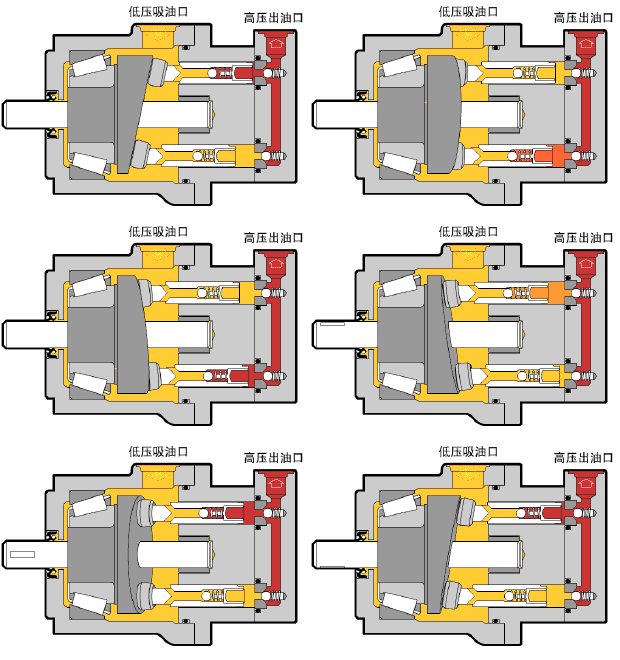
Axial plunger pump (English name: Piston pump) is a plunger pump in which the reciprocating direction of the piston or plunger is parallel to the central axis of the cylinder. The axial plunger pump uses the volume change produced by the reciprocating movement of the plunger parallel to the drive shaft in the plunger hole to work. Since the plunger and the plunger hole are both circular parts, a very high precision fit can be achieved, so the volumetric efficiency is high.
1.4, straight shaft swash plate type
The straight shaft swash plate plunger pump is divided into two types: pressure supply type and self-priming type. Most of the pressure-supply hydraulic pumps use a gas-filled oil tank, and a hydraulic oil tank that relies on air pressure to supply oil. After each start of the machine, you must wait for the hydraulic oil tank to reach the working pressure before operating the machine. If the machine is started when the air pressure of the hydraulic oil tank is insufficient, the sliding shoes in the hydraulic pump will be pulled off, which will cause abnormal wear of the return plate and pressure plate in the pump body.
1.5, radial
Radial piston pumps can be divided into two categories: valve distribution and shaft distribution. Valve distribution radial piston pump has high failure rate and efficiency
Plunger pump
Low-level shortcomings. The axial distribution radial piston pump developed in the 1970s and 1980s overcomes the shortcomings of the valve distribution radial piston pump. Due to the structural characteristics of the radial pump, the fixed shaft distribution radial piston pump is impact resistant, longer life, and higher in control accuracy than the axial piston pump. The variable of the variable stroke short pump is realized by changing the eccentricity of the stator under the action of the variable plunger and the limit plunger, and the maximum eccentricity determined is 5-9mm (depending on the displacement size), and the variable stroke is very short . And the variable mechanism is designed for high pressure operation and controlled by the control valve. Therefore, the pump has a fast response speed. The radial structure design overcomes the problem of eccentric wear of the sliding shoe of the axial piston pump. It greatly improves its impact resistance.
1.6, hydraulic
The hydraulic oil tank of the hydraulic plunger pump is supplied by air pressure. Every time the machine is started, the hydraulic oil tank must reach the air pressure before operating the machine. There are two types of straight-shaft swash plate plunger pumps: pressure-supply type and self-priming type. Most of the pressure-supply hydraulic pumps use a pneumatic tank, and some hydraulic pumps have their own supplementary sub-pumps to provide pressure oil to the hydraulic pump inlet. The self-priming hydraulic pump has a strong self-priming ability and does not require external oil supply.
2. Variable plunger pump
The pressure oil of the variable plunger pump enters the lower cavity of the variable housing through the one-way valve through the oil through holes in the variable housing of the pump body and the pump housing. When the pull rod moves downward, it pushes the servo piston down and the servo valve The upper valve port is opened, and the pressure oil in the lower cavity of the variable housing enters the upper cavity of the variable housing through the oil through hole in the variable piston. Because the area of the upper cavity is larger than the lower cavity, the hydraulic pressure pushes the piston down and drives the pin to make the variable head Rotate around the center of the steel ball, change the tilt angle of the variable head (increase), and the flow rate of the plunger pump will increase accordingly. On the contrary, the pull rod moves upward, the inclination angle of the variable head changes in the opposite direction, and the flow rate of the pump also changes. When the tilt angle changes to zero, the variable head changes to the negative deflection angle, the liquid flow changes direction, and the pump inlet and outlet ports change.
3. Dynamic diagram of the working principle of the plunger pump